
Finding meaning at work through sprint retrospectives
What truly motivates a team of twenty people spread across six countries to show up and do their best work every day? As a product designer, I was passionate about our success, but I noticed varying levels of engagement across our large, distributed team. Some members approached work with the same enthusiasm I felt, while others seemed to be going through the motions — clocking in, completing tasks, and clocking out.
After reading an intriguing book on purpose and meaning at work, I realized our bi-weekly retrospectives could be more than just process improvement sessions. They could be opportunities to uncover what actually drives each of us. What if understanding each person’s source of meaning could transform not just how we felt about work, but how we worked together?
Understanding Meaning at Work
The phrase “meaning at work” refers to a person’s experience of something meaningful, something of value that work provides.
It is a feeling that your job matters beyond completing tasks or earning a paycheck. It is about finding fulfillment, growing as a person, and feeling like what you do makes a difference.
Why does meaning at work matter?
When work feels meaningful, people are more motivated, engaged, and satisfied. That doesn’t just benefit individuals, it leads to better performance, higher creativity, and stronger retention at a team level.
How do you find meaning?
At its core, finding meaning at work is about alignment between your personal values and what your role enables you to achieve. This connection creates a sense of purpose that goes beyond completing tasks or receiving a paycheck. The book “ Purpose, Meaning + Passion” (which inspired this experiment) suggests that meaning looks different for each person, but identifying it can transform how we experience our work lives.

The Experiment: A sprint retrospective with a twist
Our team of twenty spans six different countries, with members working both remotely and on-site. While we all appreciate financial stability, I suspected there were deeper motivations that could be unlocked to create more engagement and satisfaction.
Sprint retrospectives, our bi-weekly sessions for reflecting on processes, collaboration, and team dynamics, offered the perfect opportunity to explore this. When my turn to facilitate came around, I designed a retrospective with a difference: instead of only focusing on what went well or poorly in our work, we would dive into what creates meaning for each team member.
Using insights from “Purpose, Meaning + Passion,” I created a framework that felt familiar enough to be comfortable, yet pushed us to articulate what personally drives each of us.
Types of Meaning at Work

We used these seven types of meaning as prompts in our discussion:
1. Learning
Work offers opportunities to learn, expand one’s horizon, and improve self-awareness
2. Accomplishment
Work is a place to accomplish things and be recognized
3. Status
High-status organization confers respect, recognition, and a sense of worth to you
4. Power
Work provides an arena for acquiring and exercising power
5. Belonging to a community
Feeling connected and valued within the workplace
6. Agency
What you do actually matters at the organization; your contributions have an impact on how the place performs
7. Autonomy
You have the freedom to do your work in your own time
We asked:
What’s going well? What is the meaning at work for you?
What went poorly? What isn’t the meaning of work for you, but what would you like it to be?
What ideas do you have? What can we do to make the meaning of work better for you?
How should we take action? What do you believe we should do next? What specific things should we change? What should extend beyond this meeting?

What we learned
Meaning varies by role
Team members are connected by different types of meanings depending on their role, personality, and even life stage. For example, developers tended to value autonomy and agency, the freedom to choose what they work on and the sense that their contributions make a difference. Product owners leaned more toward status and impact, appreciating visibility and recognition for driving product outcomes.
Cultural background shapes perception
With a team spread across six countries, it became clear that culture deeply influences what people value at work. In some cultures, community and belonging were strong motivators — feeling part of a cohesive, collaborative group was essential. Others prioritized learning or achievement, driven by cultural norms that value personal growth or competition. These differences helped us appreciate each other’s perspectives more and think more inclusively when planning work or defining goals.
Not everyone has reflected on the meaning at work
Interestingly, a few team members shared that they hadn’t really paused to consider what makes their work meaningful. This wasn’t due to a lack of care, it’s just not a question we often get asked. Simply naming what matters helped us think more intentionally about how we work and how we can support each other.
Discussing meaning at work unlocks motivation
Talking about meaning prompted people to reflect not just on their current roles, but on what they wanted more of at work. It made some realize they wanted to feel more connected, more challenged, or simply more fulfilled in what they do.
What changed after the retro?
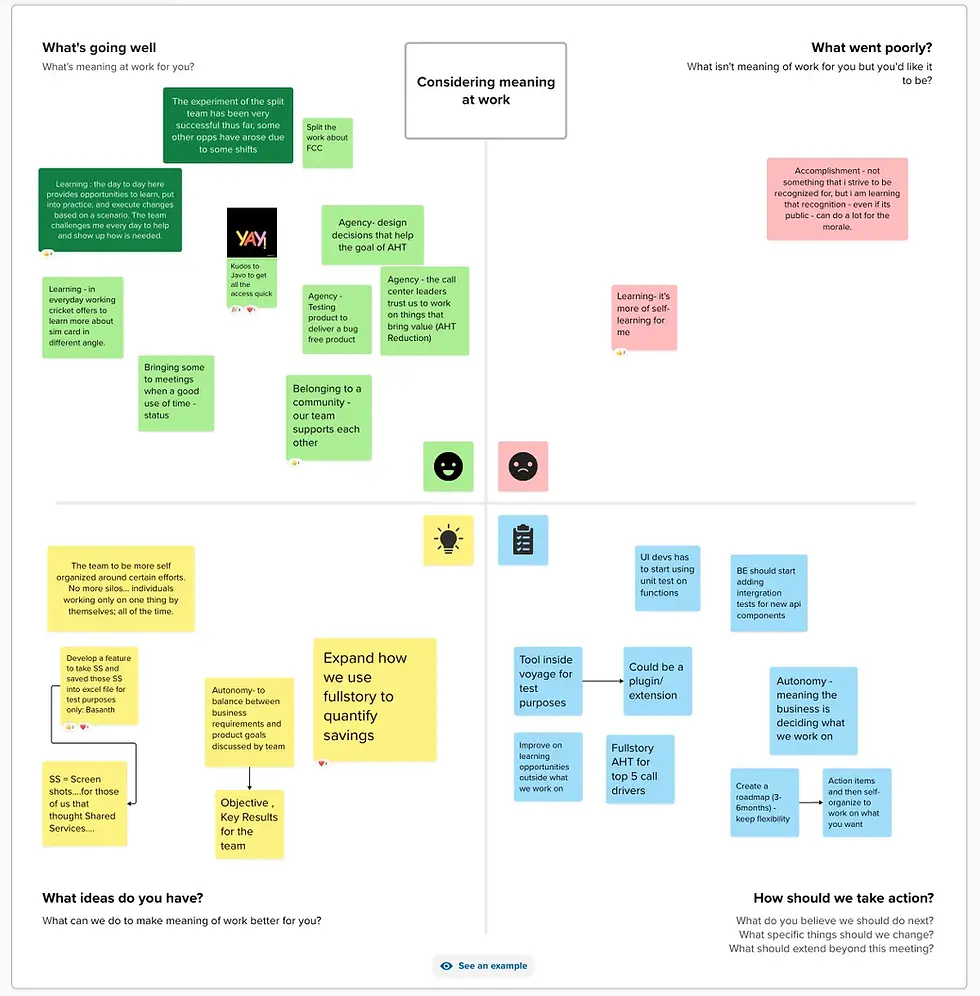
The insights that emerged from our retrospective, visible in the sticky notes above, led to meaningful shifts in how we operate as a team. While our takeaways were specific to our team, they offer a flexible framework that other teams can adapt based on their own needs and context. Here’s what changed for us:
Sprint planning got an upgrade
One of the biggest shifts came in how we plan our sprints. Before, tasks were largely assigned based on priority, leaving little room for personal interest or ownership. After the retrospective, we realized that many team members craved more autonomy, a chance to choose work that felt meaningful to them.
Now, during sprint planning, we lay out all priorities at once and let developers self-organize, picking tasks that align with their interests and strengths. This small shift boosted motivation, made people feel more in control, and encouraged greater accountability.
Improved learning opportunities, on our own terms
Learning came up repeatedly as a source of meaning. But so did the realization that not everyone learns the same way. Some team members love structured group learning; others prefer to explore topics solo, at their own pace.
Instead of mandating training sessions or activities, we committed to supporting optional learning opportunities from casual lunch-and-learns to shared resources and skill-sharing circles, encouraging personal growth without pressure.
Mapped our product roadmap to bring clarity and purpose
While we had quarterly goals, many team members expressed a desire for more visibility into the bigger picture. They wanted to know how today’s work contributes to something meaningful over time. So we built a product roadmap to give everyone a clearer view of where the product is headed and how each person’s work fits into that vision.
It was not only a planning tool, but it became a shared story that brought the team together, gave a sense of ownership, and made hitting goals feel even better. For developers eager to grow, the roadmap also highlighted areas for upskilling and exploration. And for the team at large, it helped answer a simple but powerful question: Why does this work matter?
Running a sprint retrospective focused on meaning was a refreshing experience. It helped us understand each other better, tweak our ways of working, and ultimately feel more connected as a team. Finding meaning at work is deeply personal, but reflecting on it together can unlock surprising levels of motivation and clarity.
Want to try this with your team? Use the questions in the template above, and you might discover what really motivates the people you work with every day!


Comments